 MORA
MORA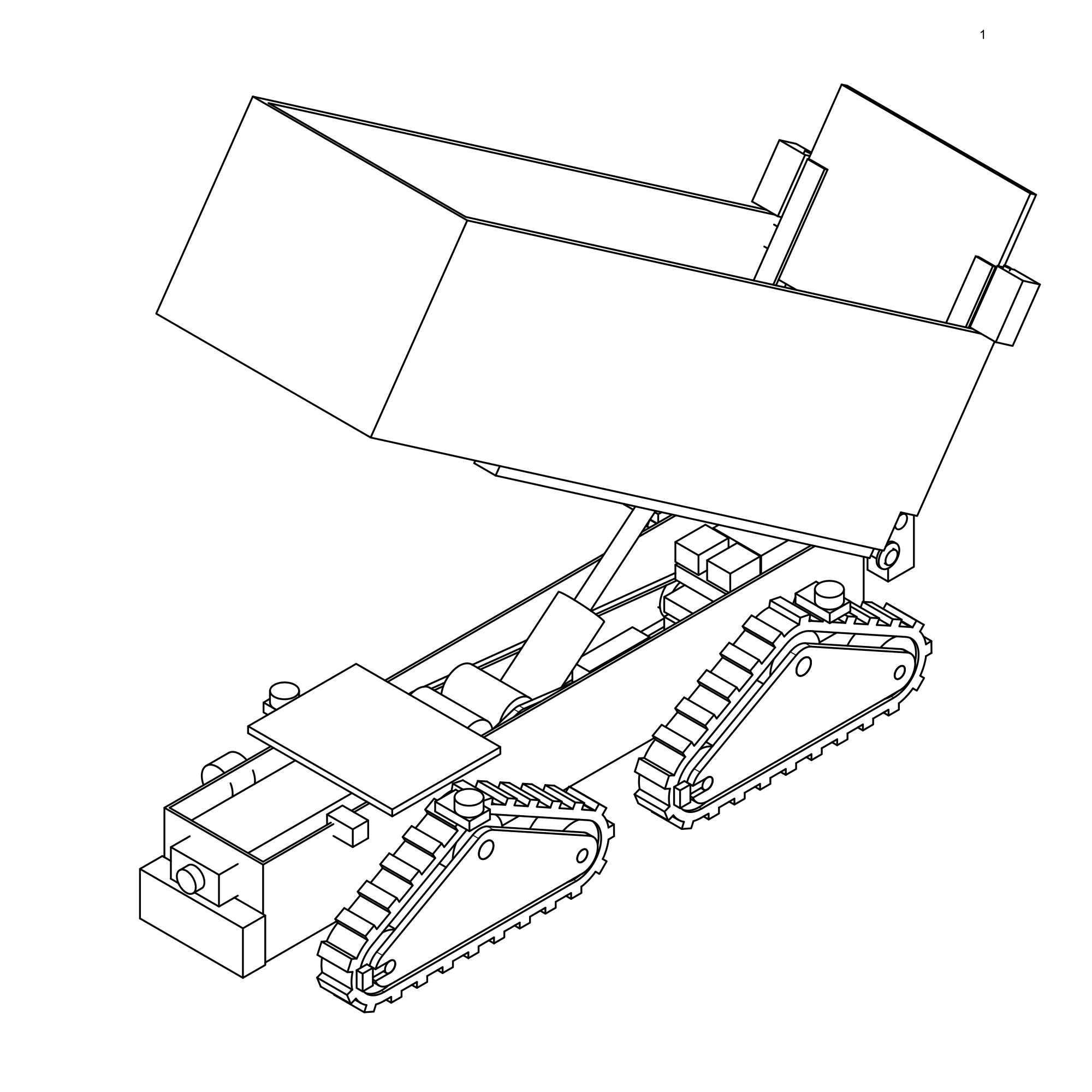
MORA Robotics
Engineered Abundance
A 275 mm furrow.
A 205 mm machine.
MORA builds autonomous field robots for Korean dry fields. The worker picks straight into the machine. When it is full, it drives itself out, tips its load, and comes back.
It fits down rows no wheeled equipment can enter.
01. Why now
The fields are emptying faster than anyone is replacing them.
Korea has the lowest fertility rate in the world. More than half the people living on Korean farms are past 65, and roughly one farm operator in a hundred is under 40.
The culture points the other way too. A generation was raised to sit the exam, move to Seoul, and take a job at a large company, not to run a farm.
Persuading that generation back to the rows by hand is not a plan. The work itself has to change shape.
- Farm population aged 65+
- 52%
- Farm operators under 40
- ~1%
- National fertility rate
- 0.75births/woman
Figures from Statistics Korea (통계청).
02. The field
No other machine fits in a furrow this narrow.
Most field robotics proposals assume furrows 400–600 mm wide and ridges 200–400 mm tall. Our own survey found furrows closer to 275 mm and ridges closer to 100 mm, roughly half the width and a quarter the height.
That is why Korea's existing follow-and-discharge robots, built for wider terrain, cannot enter a furrow this narrow.
| Dimension | Assumed | Measured |
|---|---|---|
| Furrow width | 400–600 mm | 275 mm |
| Ridge height | 200–400 mm | 100 mm |
MORA runs inside the furrow, never straddling a ridge. Straddling at this height would push any machine past 500 mm wide and cost it the slope stability that matters more.
Korean farming needs machines that work the rows, and the people who run them.
The whole machine
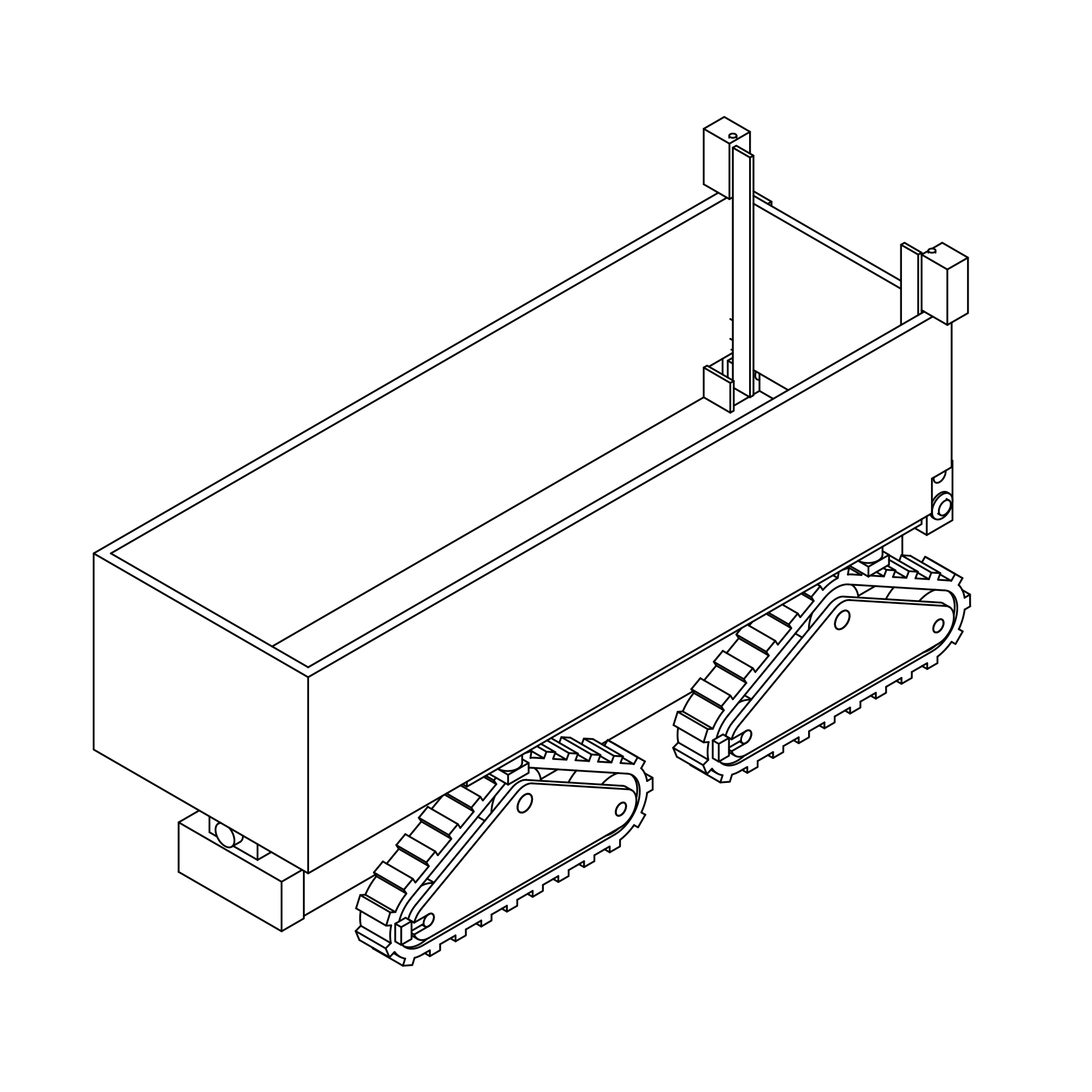
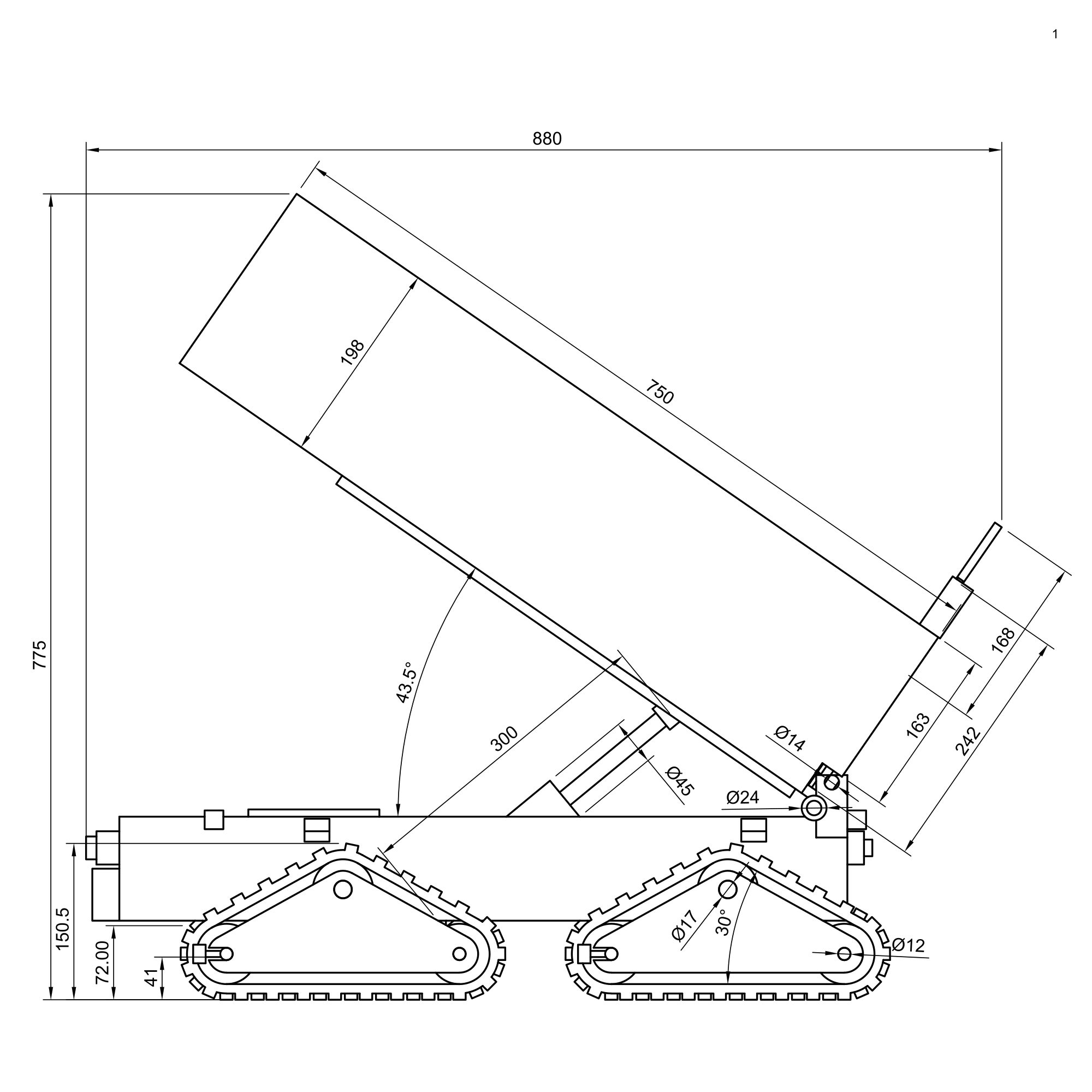
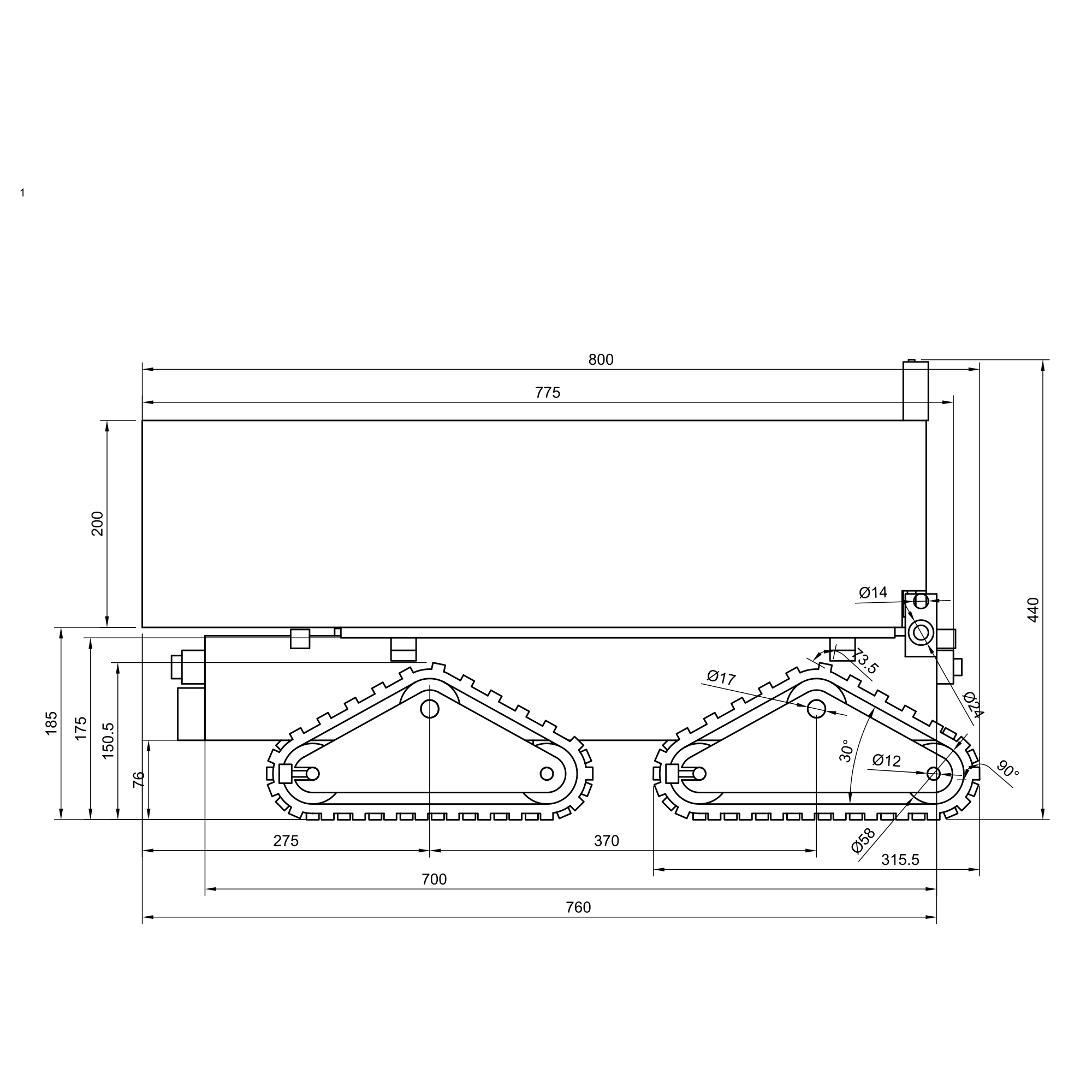
795 mm end to end, 284 mm at its widest, 39.8 kg with a full bed. Small enough to lift into a truck without a ramp.
Four pods, rocking
Each track pod pivots independently about its own apex axle, so all four stay loaded when the furrow floor is broken.
Bed up, gate open
One linear actuator lifts the bed to 43°. The guillotine tailgate rises on two leadscrews and the load leaves at the rear.
Twenty components
Two drive motors, one actuator, four identical pods. Every pod is the same part, so a spare fits any corner.
03. The machine
MORA Bot Ⅰ. Four rocking track pods, two motors, one job.
Each of the four track pods pivots independently about its own axle, so all four stay loaded on broken ground. One motor per side drives both pods on that side through a toothed belt, and steering is differential. Cleated tracks put down 12.5 kPa. That's light enough not to compact the bed you're standing on.
- Track width
- 205mm
- Belly clearance
- 76mm
- Bed volume
- 31.6L
- Mass, laden
- 39.8kg
- Slope limit
- 15°
- Ground pressure
- 12.5kPa
- Bed tilt
- 43°
- Battery swap
- <60sec
04. How it works
Teach the route once. Then just pick.
It follows you
A radio tag in your pocket keeps the machine at your heel. Two antennas set 618 mm apart give it both range and bearing, so it knows which way you are, not just how far.
You pick into it
No basket, no transfer, no bending twice. The bed is the container you were going to fill anyway.
It drives itself out
Once the bed is loaded it runs the route you taught it on the first pass, out of the row to the collection point.
It tips and returns
The bed lifts to 43°, the tailgate opens, the load goes. Then it comes back and finds you again.
05. On capacity
The bed is the basket.
MORA carries 11 kg a trip. That's less than one worker's basket. Set against a 300 kg orchard hauler, it sounds like a weakness. Here's the arithmetic.
A round trip on a 50 m row takes about four minutes. That is roughly 120 cycles in a working day and comfortably more than a tonne moved, which is more than one picker harvests. The machine is never the queue.
- 11kg+
- Per trip
- 120×
- Cycles a day
Capacity was never the bottleneck. Access is.
06. The farm we're building for
Half farmer, half engineer, half the effort.
The farmer we design for owns their ground. Their working day looks less like stooping down a row and more like running a flight line: check the machines over, plan the routes, read what came back off the field, fix what broke. Crop expertise and mechanical competence in the same person.
One operator, one farm. A fleet that does the walking. That's the direction of travel. MORA Bot Ⅰ follows a single worker today. Coordinated multi-machine operation is the step after it.
07. The name

募羅
MORA is written with two hanja (한자), chosen to hold both halves of the company at once: what we gather from the field, and the network we build to connect it.
Read together, 募羅 is a network that gathers, connects, and coordinates. That's also a fair description of a fleet of machines working a field together. The two syllables were picked to stay easy to say in any language.
Engineered Abundance
The act of assembly. Swarm coordination in the field, fleets brought together as one, and real-time spatial data pulled into a single picture.
The technological foundation. Distributed autonomy, interconnected robot fleets, and coverage that scales across the acreage.
08. Contact
The MORA Bot Ⅰ design is complete. We are building the first field unit.
If you farm dry field crops, distribute agricultural equipment in Korea, or invest in hard engineering, we would like to hear from you.